
The Battle of Culloden on 16 April 1746
The Battle of Culloden was the decisive defeat of the last Jacobite rising, fought on 16 April 1746. The Jacobites sought the restoration of the Stuart monarchy and faced government forces commanded by the Duke of Cumberland. Understanding those political aims gives the battlefield a clearer meaning than treating the opposing armies as national teams.
Culloden is described as the last open pitched battle on British soil. The fighting lasted less than an hour, but the surviving landscape and later memorials invite a slower visit. The field contains fighting lines, graves and a central cairn. Read these as different parts of the story: where armies fought, where the dead are remembered, and how later generations marked the ground.
Reading the fighting lines
Culloden's fighting lines help explain the relationship between the armies and the wet ground. Following artillery fire, the Jacobites attacked. Close fighting developed on the government left, while wet terrain made the attack in the north more difficult. Government units also used the southern enclosure to fire into the attackers' flank.
Use the field to place those movements rather than imagining a single uniform charge across identical terrain. The contrast between positions matters: an account of close fighting in one area does not describe every part of the battle. For objects and interpretation from both sides, the visitor centre offers a separate indoor part of the visit.
The cairn and clan stones of 1881
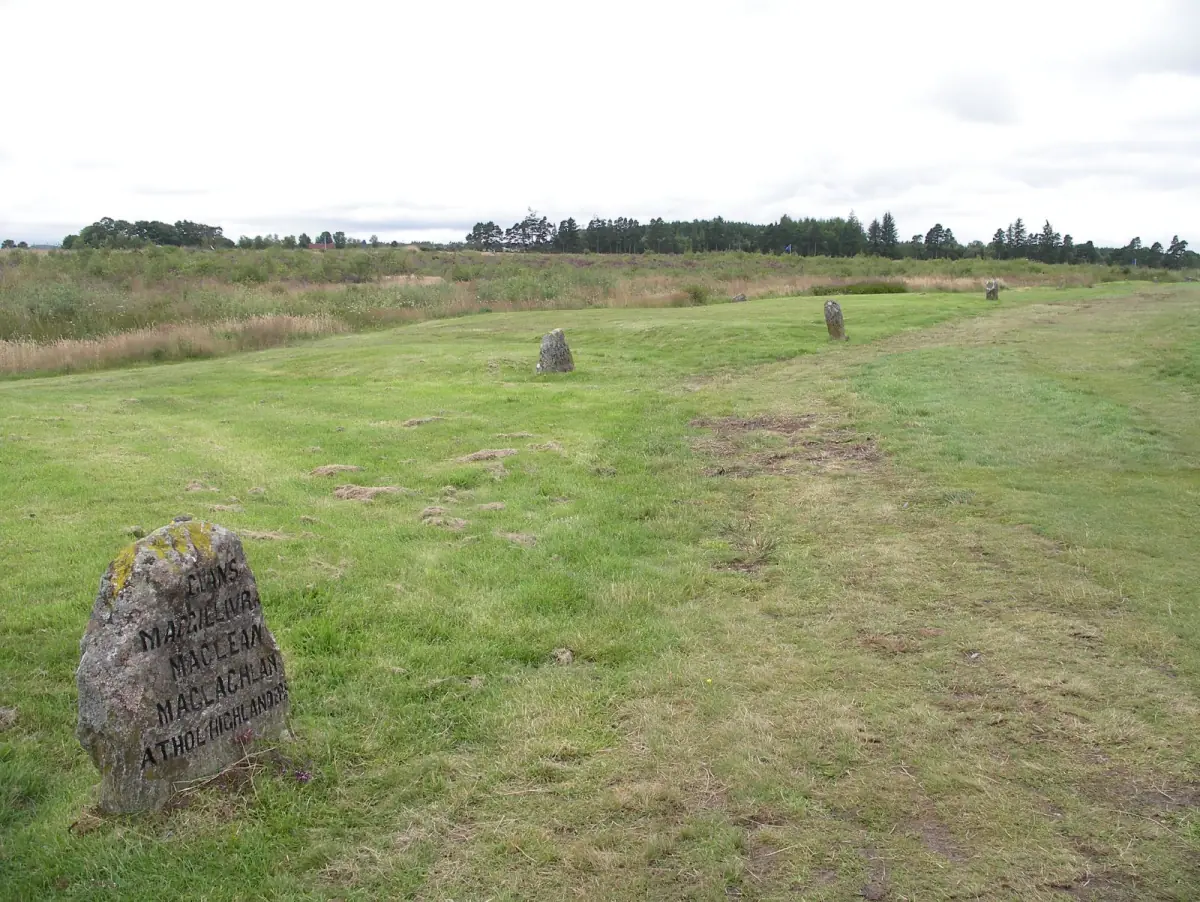
Culloden's memorial cairn and grave markers were erected in 1881 by landowner Duncan Forbes. The stones belong to the history of remembrance, rather than to the day of the battle itself. An earlier memorial tower had been built west of the battlefield by Lachlan Mackintosh in the 1820s.
Clan names can be an important reason for visiting, especially for people with family connections to the Highlands. Read each marker as a memorial, rather than as a precise archaeological register of every person beneath it. Allow room for other visitors to pause and keep to the paths around sensitive grave areas. A quiet walk leaves space for both personal remembrance and historical understanding.
Leanach Cottage and the earlier farmstead
Leanach Cottage is the surviving part of Old Leanach, an early eighteenth-century farmstead on the battlefield. The two names describe related parts of the same site. The building adds a domestic scale to a landscape otherwise understood through armies, positions and memorials.
The cottage underwent extensive restoration in 1960, so the present building should be understood as restored historic fabric. Its entrance is low and narrow, and uneven stone surfaces are another consideration for anyone with limited mobility. Include the exterior in the field walk without making access to the interior essential to the day.
Remembrance and the limits of the surviving evidence
Culloden's memorial landscape records how the battle has been remembered as well as where it was fought. Keep the date of the battle, the dates of later structures and the purpose of grave markers distinct. A later monument can carry deep significance without being an object left by the armies in 1746.
The anniversary falls on 16 April; a ceremony listed for 18 April 2026 has already taken place. Plan a commemorative visit around a newly published event announcement rather than carrying forward that past programme. For an ordinary field visit, use the arrival guide and weather and seasonal planning. The exposed moor and sloping paths can become muddy, so bring weather protection and shoes with grip.
Questions about Culloden's history
When was the Battle of Culloden?
16 April 1746 was the date of the Battle of Culloden, the decisive defeat of the last Jacobite rising. The Jacobites sought to restore the Stuart monarchy and fought government forces under the Duke of Cumberland. The fighting lasted less than an hour on the open moor.
What do the clan stones represent?
Culloden's clan stones are grave markers erected in 1881 alongside the memorial cairn. They form part of the site's later remembrance landscape. Treat their inscriptions as memorials to those who died, rather than a precise archaeological list of every individual buried beneath each named stone.
How should I include Leanach Cottage in a history walk?
Leanach Cottage can be considered alongside the fighting lines and memorials as the surviving part of an earlier farmstead. Extensive restoration took place in 1960. The low, narrow entrance and uneven stone surfaces make access a separate consideration from walking the surrounding battlefield and viewing the building outside.